
Read summarized version with
 ChatGPT
 Perplexity
 Gemini
 Claude
 Grok
Grok
Key takeaways
- Generative AI adoption across organizations reached 88% in 2025, according to McKinsey, meaning employees are almost certainly using these tools already, whether or not a governance policy is in place.
- An effective policy classifies data into three tiers: public data permitted across sanctioned tools, internal or confidential data restricted to enterprise-tier tools with verified zero-data-retention agreements, and restricted data, including personally identifiable information, protected health information, and financial statements, that must never enter any generative AI tool.
- Employees who accidentally expose restricted or confidential data are instructed to report the incident immediately, including the tool used, the data type, and the approximate exposure time, without attempting to delete or conceal it, and good-faith reporting should not trigger disciplinary action.
- Software engineering guardrails require that AI-generated code snippets undergo the same peer-review and automated static application security testing pipelines as human-written code, and that no AI-generated code be committed to production without manual verification.
- Shadow AI risk arises when employees use consumer-grade tools like the free tiers of ChatGPT, Claude, or Gemini for work, since submitted data can be used to train public models or retained in ways the organization cannot audit.
- Adaptive Security's approach moves beyond static policy documents by translating an uploaded written policy into live, browser-native enforcement that delivers targeted coaching to employees at the moment they violate an AI boundary.
The adoption rate of generative AI across the enterprise landscape is staggering. Whether you are aware of it or not, your employees are already using it, and that presents unique legal hurdles for your company.
AI use across organizations reached 88% in 2025, according to McKinsey. Employees are eager to use these tools to accelerate their daily tasks, and the operational efficiencies are undeniable.
Yet, when teams adopt applications without official approval, they introduce unmanaged shadow IT risk into the corporate network. To safely harness the power of AI, teams need more than simple verbal agreements. They require a formal AI governance framework.
Without clear, documented boundaries, organizations expose themselves to severe data privacy violations, regulatory fines, and the loss of proprietary intellectual property. Establishing a robust policy is the critical first step toward effective human risk monitoring and mitigation.
What Is an AI Governance Policy?
An AI governance policy is a foundational document that establishes the acceptable use, data security protocols, and human accountability requirements for generative software.
The policy serves as the single source of truth for how your workforce is expected to interact with automated systems, separating sanctioned innovation from dangerous data exposure.
A comprehensive framework covers all forms of the technology. This includes:
- Large language models (LLMs)
- Automated text generators
- Image creators
- Voice cloning applications
- Automated code completion assistants
A strong policy also applies to all business operations, regardless of device ownership, network location, or account type.
Using a personal device or a home network does not exempt personnel from the organization's rules. Whether an employee is drafting an email on a corporate laptop in the office or summarizing a document on a personal tablet at a coffee shop, the data-handling expectations remain the same.
3 Reasons Every Organization Needs an AI Framework
Many security leaders know they need an AI governance policy but haven’t put one in place, and delaying the creation of these guidelines exposes the entire business to several severe vulnerabilities.
1. Mitigating Data Exfiltration
Without clear rules, employees may submit proprietary corporate data, internal memos, or strategic plans to unverified models.
Unsanctioned applications often use submitted data to train public models or retain it in ways the organization cannot audit. This creates an unmonitored vector for the exposure of corporate data.
Imagine a sales director uploading a quarterly forecasting spreadsheet to a public chatbot to generate an executive summary. That sensitive financial data is now entirely out of the organization's control. A documented policy clarifies exactly why these actions carry immense risk.
2. Controlling Shadow AI
When employees use consumer-grade AI tools (think ChatGPT, Claude, or Gemini free tiers) for work, your data goes somewhere you can't audit or control. A formal framework allows leadership to separate approved software from unauthorized software.
Employees are required to use only the explicitly sanctioned applications listed in the corporate software catalog. These approved tools are deployed within environments that ensure data isolation and strict privacy protection.
Establishing an explicit allowlist provides clear direction, so personnel never have to guess if a trending application is safe to use.
3. Establishing Human Accountability
Generative models function strictly as text- and data-processing assistants. They are prone to hallucinations, factual errors, and the fabrication of source materials.
An AI framework dictates that ultimate accountability and legal liability for the integrity and factual accuracy of all work products remain solely with the human user.
Automated generation does not excuse professional negligence. If a marketing manager uses an AI image generator to create assets, they are responsible for verifying that the image does not infringe on existing copyrights.
Core Components to Include in an AI Security Policy
Creating an effective governance document requires specific, actionable guidelines. When you begin drafting your framework, ensure you cover the following operational areas.
Clear Data Classification Boundaries
To prevent data exfiltration, information entered into any generative AI system is expected to strictly adhere to organizational data classification boundaries.
- Public Data: Public data might be permitted across all sanctioned tools. Because this information is already available to external audiences, running it through a vetted language model poses negligible risk.
- Internal or Confidential Data: Internal or confidential data should be processed exclusively through enterprise-tier tools that possess verified zero-data-retention agreements.
- Restricted Data: Information categorized as restricted data is never to enter any generative AI tool. No exceptions apply. This includes personally identifiable information, protected health information, and corporate financial statements.
Access Request Workflows
Your framework needs to provide a safe path for employees to request new tools.
Employees who require the use of a generative AI application not currently on the approved allowlist are expected to submit a formal request through the proper approved internal channels.
The security team then reviews the application based on vendor data retention agreements, compliance certifications, and underlying risk profiles before granting operational approval.
Incident Reporting Protocols
If restricted or confidential data is entered into a generative AI tool, the incident must be reported immediately through the organization's approved security reporting process.
The policy instructs employees not to attempt to delete, conceal, or correct the exposure on their own.
They should submit a report detailing the tool that was used, the type of data that was entered, and the approximate exposure time.
No disciplinary action should be presumed for good-faith reporting of accidental exposure. Prompt reporting allows the organization to assess risk and reduce the chance of further exposure.
Ethical and Bias Reviews
Outputs generated by AI models can mirror systemic biases present within their training data.
Users are required to review all automated content to ensure it aligns with corporate ethics policies, professional standards, and non-discrimination mandates before the content is shared or published.
Software Engineering Guardrails
If your organization engages in internal software development, you are required to address code completion assistants.
Engineering personnel may use approved AI code-completion assistants only within authorized integrated development environments.
All code snippets or scripts generated by AI tools must undergo the same peer-review protocols and automated static application security testing pipelines as human-written code.
Automated output should not be committed to production environments without manual verification, as AI-generated code frequently introduces logic flaws and security vulnerabilities.
Evaluating Policy Enforcement Strategies
A policy is only effective if it is consistently enforced. Organizations typically choose between two primary approaches to managing employee behavior. They are only as good as their enforcement.
| Enforcement Strategy | Implementation Method | Security Outcome |
|---|---|---|
| Passive Documentation | Employees sign a written acknowledgment of the rules | High risk, relying entirely on human memory and compliance intent |
| Active Human Risk Monitoring | Software continuously monitors interactions directly within the enterprise browser layer | High security, blocking unsanctioned actions in real time and provides immediate coaching |
No matter how you choose to handle the increasing exposure, you need to pick a tactic and stick with it.
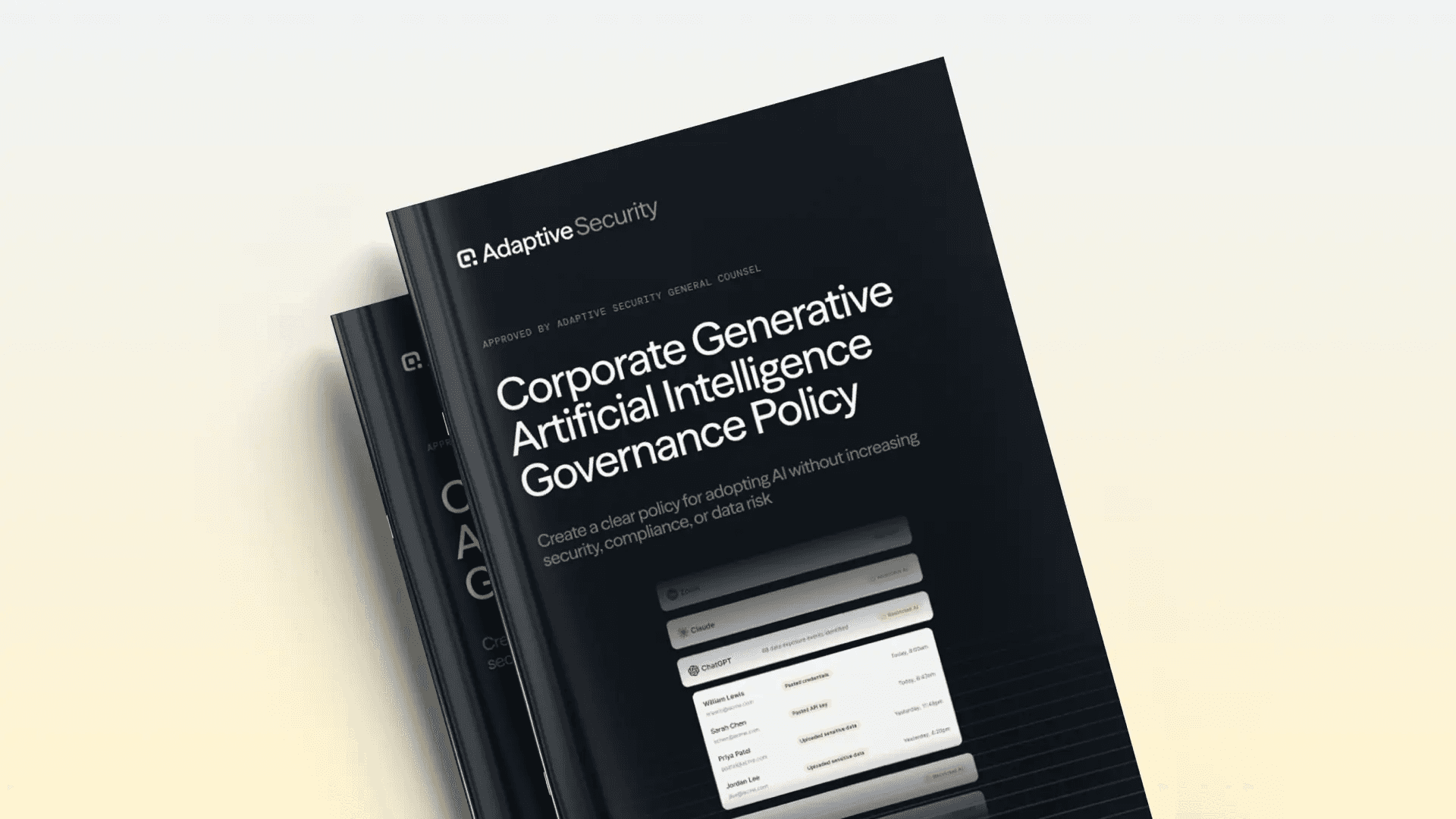
Use This Free AI Governance Policy Template
Building a comprehensive framework from scratch is a time-consuming process. To help you quickly secure your environment, we have created a ready-to-download template to solve this high-urgency problem.
Adaptive Security’s AI Governance Policy Template provides pre-written sections covering everything from access control workflows to human-in-the-loop mandates and intellectual property guidelines.
The free template also includes an employee acknowledgment section in which signatories confirm a full understanding of the compliance rules, data restrictions, and the absolute requirement for human accountability for AI-generated work products.
Move Beyond Static Documents with Adaptive Security
Written guidelines are necessary, but they cannot physically stop a busy employee from pasting sensitive intellectual property or customer records into a public generative model. Security teams cannot manage what they cannot see.
Adaptive Security provides continuous, browser-native visibility and automated policy enforcement with zero tuning.
Our platform allows you to upload your existing written policy and automatically translates the directives into live, browser-native enforcement paths.
When an employee violates an AI boundary, the platform delivers targeted coaching directly in the browser, changing employee behavior at the exact moment of risk.
Don’t leave corporate data security to chance or rely on static policy compliance signatures.
Schedule an Adaptive Security demo today to establish complete visibility, discover shadow AI sprawl, and reduce your corporate attack surface.

As a technology reporter-turned-marketer, Justin's natural curiosity to explore unique industries allows him to uncover how next-generation security awareness training and phishing simulations protect organizations against evolving AI-powered cybersecurity threats.
Frequently Asked Questions.
Yes. A comprehensive policy applies to all business operations, regardless of whether you are using a corporate laptop, a personal tablet, or a home internet network. The data handling requirements remain the same across all environments.
Employees are expected to report the incident immediately through the approved internal security channels. They are explicitly instructed not to attempt to conceal or delete the exposure themselves. Good-faith reporting allows the security team to mitigate the risk quickly without presuming disciplinary action.
Public-tier, consumer-grade applications are restricted because they frequently use submitted data to train their open models or retain data in ways the company cannot audit. This lack of data isolation creates a massive, unmonitored vector for corporate data exposure.
Related articles

Shadow IT Audit Checklist: 12 Steps to Find, Assess, and Govern Hidden Tools Across the Organization at Scale

AI Governance Roadmap: A 30-90-180-365 Day Plan for Controlling Risk and Enabling Responsible Innovation

